Have you ever seen the term SMS on your phone and wondered what it actually means? You’re not alone. Many people use texting every day but don’t fully understand this basic term.
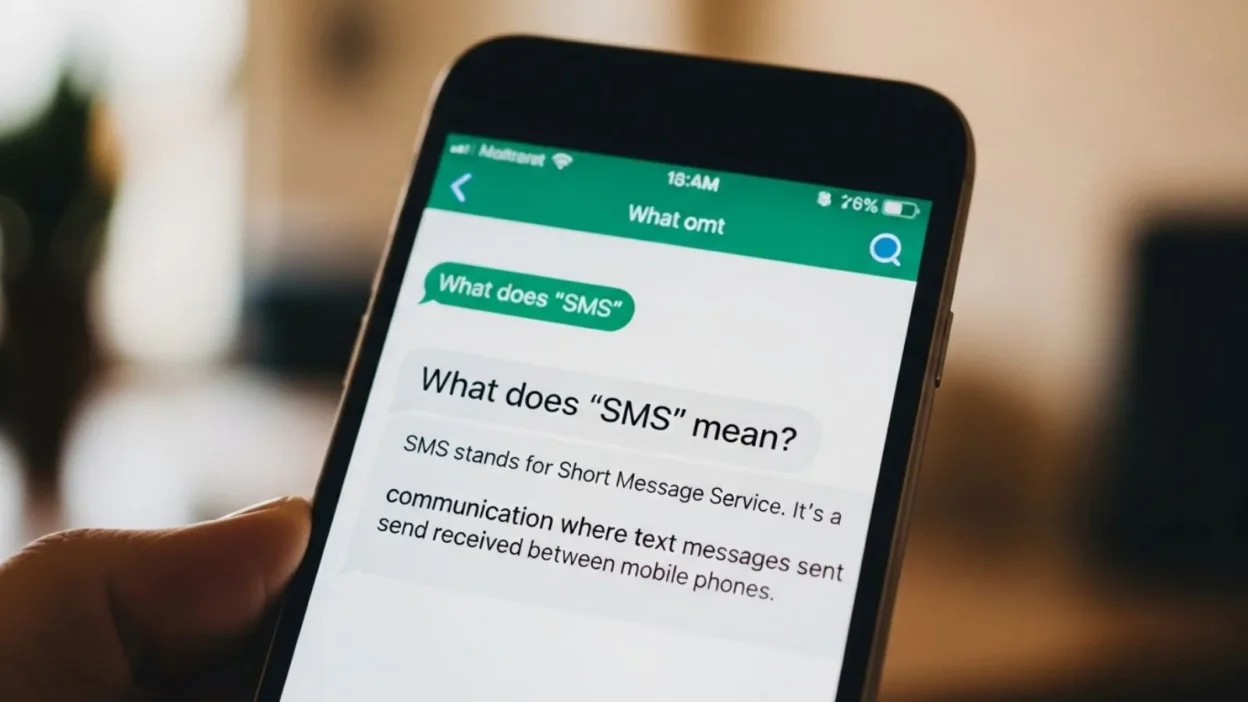
In simple words, SMS stands for Short Message Service, which is the standard way to send text messages between mobile phones.
Unlike modern apps like WhatsApp, SMS does not require an internet connection. It works through your mobile network, making it reliable even without Wi-Fi.
From personal chats to important alerts like bank messages and verification codes, SMS plays a big role in daily communication. In this guide, you’ll learn the SMS meaning in text, how it works, real-life examples, and how it differs from other messaging options.
What Does SMS Mean in Text?
SMS in text simply means Short Message Service. It is the basic service that allows people to send and receive text messages using mobile phones. When someone says they sent you an “SMS,” they are just talking about a regular text message that goes through your mobile network instead of the internet.
The term became popular in the early days of mobile phones, long before apps like WhatsApp existed. Back then, SMS was the main way people communicated quickly without making a phone call. Even today, the word “SMS” is still used in phone settings, notifications, and by businesses.
One important thing to understand is that SMS works without Wi-Fi or mobile data. It uses your SIM card and your mobile carrier’s network to send messages. This is why you can still send an SMS even when your internet is off or unavailable.
SMS messages are usually limited to 160 characters per message, which encourages short and clear communication. Because of this, people often keep their texts simple and direct.
You will commonly see SMS used for:
- Personal messages between friends and family
- One-time passwords (OTP) for login security
- Bank alerts and service notifications
- Appointment reminders and business updates
In short, SMS is the original and most basic form of texting, and it remains an important part of communication even today.
What Is SMS Full Form in Chat and Texting?
The full form of SMS is Short Message Service. This name might sound a bit technical, but it simply describes a system that allows people to send short text messages from one phone to another. In everyday chatting, when someone mentions SMS, they are referring to a standard text message sent through a mobile network.
Let’s break it down in a simple way. The word “Short” means messages are brief, usually limited to 160 characters. “Message” refers to the text you send, like a quick note or update. “Service” means it is a feature provided by your mobile carrier, not something that depends on the internet. Together, Short Message Service is just a formal way of saying “text messaging system.”
In modern texting, people often use the word “text” instead of SMS, but both usually mean the same thing. However, there is a small difference. SMS is the technical term used by phones and networks, while “texting” is the casual term people use in daily conversation.
For example, if your phone says “Send as SMS,” it means the message will go through your mobile network instead of an internet-based app like WhatsApp. This is helpful when your internet is not working.
Understanding the full form of SMS helps you see how basic mobile communication works. Even with advanced chat apps today, SMS remains a simple and reliable way to send messages anytime, anywhere.
How Does SMS Work on Mobile Phones?
SMS may look simple on the surface, but there’s a clear process happening behind the scenes. When you type a message and hit “send,” your phone does not use the internet. Instead, it sends the message through your mobile network using your SIM card.
Here’s how it works step by step. First, your message is sent from your phone to a nearby cell tower. From there, it goes to a system called the Short Message Service Center (SMSC), which is managed by your mobile carrier. The SMSC acts like a middleman. It receives your message, stores it for a short time, and then forwards it to the recipient’s network.
Once the message reaches the receiver’s network, it is delivered to their phone. If their phone is turned off or out of coverage, the SMSC will keep the message and send it once the phone becomes available again. This is why SMS is considered very reliable.
Another key point is that SMS does not need Wi-Fi or mobile data. As long as your phone has signal, you can send and receive messages. This makes SMS different from apps like WhatsApp, which require an internet connection.
Because SMS uses a network-based system, it works on almost all mobile devices, from basic phones to smartphones. This simple but effective process is what keeps SMS useful, even in today’s world of advanced messaging apps.
Examples of SMS in Everyday Texting
SMS is something most people use daily, often without even thinking about it. It appears in many parts of our routine, from personal chats to important notifications. Understanding real-life examples can make the meaning of SMS much clearer.
One common example is personal messaging. You might send a quick SMS like:
- “I’ll call you later.”
- “Where are you?”
- “Don’t forget the meeting at 5.”
These short and simple messages are perfect for SMS because they don’t need internet access and are delivered quickly.
Another major use of SMS is security and verification. Many websites and apps send a one-time password (OTP) to your phone through SMS when you log in or sign up. This adds an extra layer of safety to your accounts.
SMS is also widely used for bank alerts and service updates. For example, you might receive messages like:
- “Your account was credited with Rs. 5,000.”
- “Your package has been delivered.”
- “Reminder: Your appointment is tomorrow.”
Businesses rely on SMS because it works even without internet, unlike apps such as WhatsApp.
In addition, companies use SMS for marketing messages, promotions, and customer notifications. Even governments use SMS to send emergency alerts or public updates.
These everyday examples show that SMS is not just for chatting—it plays an important role in communication, security, and information sharing across many areas of life.
SMS vs MMS vs Instant Messaging Apps
To fully understand SMS, it helps to compare it with similar messaging options like MMS and modern chat apps. While they may seem similar, they work in different ways and serve different purposes.
📌 SMS vs MMS
MMS stands for Multimedia Messaging Service. It is an upgraded version of SMS that allows users to send media such as images, videos, and audio files. In contrast, SMS is mainly limited to plain text messages with a 160-character limit.
Another difference is cost and size. MMS messages are usually larger and may cost more than standard SMS, depending on your mobile plan. While SMS is simple and lightweight, MMS adds more features but may not be supported equally on all devices or networks.
📌 SMS vs Instant Messaging Apps
Modern messaging apps like WhatsApp and Messenger offer advanced features such as voice notes, video calls, group chats, and media sharing. However, these apps require an internet connection (Wi-Fi or mobile data) to work.
SMS, on the other hand, does not rely on the internet. It uses your mobile network, which makes it more reliable in areas with weak or no internet access. This is why SMS is still widely used for important messages like OTPs and alerts.
Why Is SMS Still Used Today?
Even with the rise of modern messaging apps, SMS remains an important part of communication. One of the biggest reasons is its reliability. SMS works through the mobile network, so it does not depend on internet access. As long as your phone has signal, you can send and receive messages. This makes it very useful in areas where Wi-Fi or mobile data is weak or unavailable.
Another key reason is security. Many services use SMS to send one-time passwords (OTPs) for account verification. Banks, online platforms, and apps rely on SMS because it reaches users instantly and works on all types of phones. Even if you don’t use apps like WhatsApp, you can still receive important security codes via SMS.
SMS is also universal. It works on every mobile device, from basic feature phones to the latest smartphones. Unlike internet-based apps, there’s no need to install anything or create an account. This makes SMS accessible to people of all ages and tech levels.
Businesses and organizations continue to use SMS for alerts and updates, such as appointment reminders, delivery notifications, and emergency messages. These messages are more likely to be seen because SMS notifications appear directly on your phone.
In simple terms, SMS is still used today because it is simple, reliable, secure, and widely accessible, making it a dependable communication tool in any situation.
Advantages and Disadvantages of SMS
SMS is a simple and widely used communication method, but like any technology, it has both strengths and limitations. Understanding these helps you know when SMS is useful and when other options might be better.
✅ Advantages of SMS
One of the biggest advantages of SMS is that it does not require an internet connection. As long as your phone has a mobile signal, you can send and receive messages anywhere. This makes it very reliable, especially in areas with poor connectivity.
Another advantage is its simplicity. SMS works on all mobile phones, including basic feature phones and smartphones, without needing any apps or setup. You don’t need to install anything or create an account.
SMS is also fast and direct. Messages are delivered quickly and are often read within minutes. This is why it is commonly used for important alerts like OTPs, bank notifications, and service updates.
❌ Disadvantages of SMS
However, SMS has some limitations. The most common one is the character limit of 160 characters, which restricts longer messages. If you want to share media like photos or videos, SMS cannot handle that.
Another drawback is that SMS can be costly depending on your mobile plan, especially for international messages.
Lastly, SMS lacks advanced features like group video calls, voice notes, or file sharing, which are available in apps like WhatsApp.
Where Is SMS Commonly Used?
SMS is still widely used across many areas of daily life because of its simplicity and reliability. Even with modern messaging apps, SMS remains an important communication tool for both personal and professional purposes.
📱 Personal Communication
SMS is often used for quick personal messages when people want to send short updates like reminders, greetings, or urgent notes. It is especially useful when internet access is not available.
🏦 Banking and Security
One of the most important uses of SMS is in banking and online security. Banks send alerts about transactions, balance updates, and fraud warnings. Most importantly, SMS is used to send one-time passwords (OTPs) for login verification and secure payments.
🏢 Business Communication
Many companies use SMS to communicate with customers. They send appointment reminders, delivery updates, and service notifications. SMS marketing is also common for promotions and offers because messages are usually read quickly.
🚨 Government and Emergency Alerts
Governments use SMS to send public safety alerts, weather warnings, and emergency notifications. Since SMS works without internet, it is very effective during crises.
📦 Delivery and Service Updates
Courier companies and online stores use SMS to inform customers about order confirmations, shipping status, and delivery times.
While apps like WhatsApp are popular for rich communication, SMS remains essential for critical and instant information delivery. Its wide usage proves that SMS is still a trusted and universal communication method in today’s digital world.
Common Misunderstandings About SMS
Even though SMS is widely used, many people still have some confusion about what it actually means and how it works. Clearing up these misunderstandings helps you better understand modern communication.
❌ SMS is the same as internet messaging
One common mistake is thinking SMS works like apps such as WhatsApp. In reality, SMS does not use the internet. It works through your mobile network using your SIM card, while messaging apps require Wi-Fi or mobile data.
❌ SMS and text messages are different
Some people believe SMS and “text messages” are two separate things. However, they are basically the same. SMS is the technical term (Short Message Service), while “texting” is the everyday word people use.
❌ SMS can send photos and videos
Another misunderstanding is that SMS can send media files. Standard SMS only supports plain text. If you send images, videos, or audio, that becomes MMS (Multimedia Messaging Service), which is different from SMS.
❌ SMS is outdated and useless
Many people think SMS is no longer important because of modern apps. But this is not true. SMS is still widely used for OTPs, bank alerts, and emergency notifications because it works without internet and reaches almost every phone.
❌ SMS needs an app
❌ SMS needs an app
Unlike chat apps, SMS does not require installation or registration. Every mobile phone already supports it by default.
FAQs About SMS Meaning in Text
❓ What does SMS stand for in texting?
SMS stands for Short Message Service. It is the standard system used to send short text messages between mobile phones through a cellular network.
❓ Is SMS the same as a text message?
Yes, in most cases SMS and text messages mean the same thing. SMS is the technical term, while “text message” is the everyday word people use in daily conversation.
❓ Do you need internet for SMS?
No, SMS does not require internet. It works through your mobile network using your SIM card, which is why you can send SMS even without Wi-Fi or mobile data.
❓ What is SMS used for?
SMS is used for personal texting, bank alerts, one-time passwords (OTPs), delivery updates, and important notifications from businesses and services.
❓ What is the difference between SMS and messaging apps?
SMS works without internet and is limited to text only. Apps like WhatsApp need internet but offer extra features like voice calls, images, and videos.
❓ Is SMS free or paid?
It depends on your mobile plan. Some networks offer free SMS bundles, while others charge per message, especially for international texting.
❓ Why is SMS still important today?
SMS is still important because it is simple, reliable, and works on all phones, making it ideal for critical alerts and secure communication.
Conclusion
SMS, or Short Message Service, remains one of the most important and reliable ways of communication even in today’s digital world. It is simple to use, works without internet, and is supported by almost every mobile phone.
From personal chats to bank alerts and security codes, SMS plays a key role in everyday life.
While modern apps like WhatsApp offer advanced features such as voice calls, video sharing, and group chats, SMS still stands strong because of its universal accessibility and reliability.
It ensures that important messages can always reach users, even in areas with poor internet connection.