
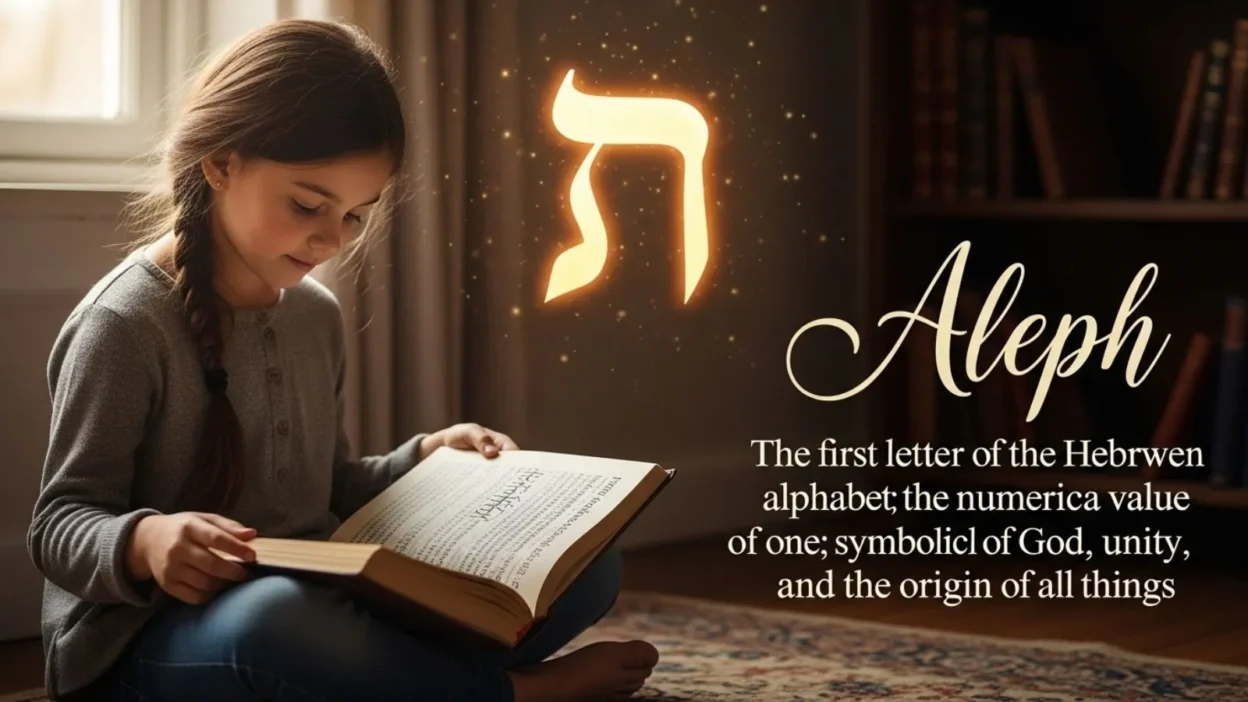
The term Aleph holds a special place in history, spirituality, literature, and mathematics. As the first letter of the Hebrew alphabet, Aleph carries layers of meaning that go far beyond a simple character.
From its origins in ancient Hebrew scripts to its mystical interpretations in Kabbalah, Aleph symbolizes beginnings, potential, and the unseen forces of the universe.
Its significance extends to literature, most famously in Jorge Luis Borges’ story “The Aleph,” where it represents infinity and the all encompassing nature of knowledge.
That mathematics, Aleph numbers, including Aleph-null (ℵ₀), are used to describe different sizes of infinity, bridging the worlds of language, spirituality, and science.
If you’re exploring the spiritual symbolism of Aleph, its role in Hebrew gematria, or its philosophical presence in literature, understanding the Aleph meaning opens a fascinating window into culture, thought, and the human quest for knowledge.
Origin and History of Aleph
The story of Aleph begins thousands of years ago in the ancient Semitic world, where early civilizations developed the first alphabetic systems. Aleph is widely recognized as the first letter of the Hebrew alphabet, and its origins can be traced back to the Phoenician letter “ʾālep,” which itself represented an ox. This connection to the ox symbolizes strength, leadership, and beginnings—a fitting introduction to a letter that starts the alphabet and marks the start of words and ideas.
Over time, the symbol evolved in shape and meaning. From the angular Phoenician script, it gradually transformed into the square form seen in modern Hebrew, while retaining its core identity. The name “Aleph” itself is thought to derive from a word meaning “ox” in Semitic languages, emphasizing the symbolic link between the letter and concepts like power, guidance, and potential.
Aleph’s historical journey is not just about language; it also laid the foundation for numerology and mysticism in later traditions. In Hebrew gematria, Aleph is assigned the numerical value of one, representing unity and the oneness of God. This dual role as both a letter and a number helped Aleph gain significance in Jewish thought, literature, and philosophy.
By understanding the origin and history of Aleph, we can see how a single letter became a symbol of beginnings, strength, and infinite possibility—a concept that continues to influence language, culture, and even modern mathematics.
Aleph in the Hebrew Alphabet
In the Hebrew alphabet, Aleph holds the distinguished position as the very first letter, symbolizing beginnings, leadership, and potential. Unlike many letters, Aleph is a silent letter; it has no inherent sound on its own but adopts the vowel sounds associated with it in a word. This unique characteristic makes Aleph both subtle and profound—a small symbol that carries immense weight in language, meaning, and symbolism.
Aleph is also closely tied to Hebrew numerology, or gematria, where it is assigned the numerical value of one. This association represents unity, the oneness of God, and the origin of all things. Its position at the start of the alphabet reinforces its role as a symbol of creation and the first step in communication and expression.
The shape of Aleph itself is symbolic in mystical interpretations, these components represent the connection between heaven and earth, the spiritual and the physical, and the human and divine. This geometric symbolism adds a layer of depth beyond its linguistic function, making Aleph a letter that resonates with meaning across multiple dimensions.
Understanding Aleph in the Hebrew alphabet reveals why it is more than just a letter. It is a symbol of beginnings, spiritual connection, and unity. Its presence in language, numerology, and symbolism has made it a cornerstone of Hebrew culture and a source of inspiration in literature, philosophy, and spiritual studies.
Spiritual and Mystical Significance of Aleph
Beyond its linguistic role, Aleph carries profound spiritual and mystical meanings, especially within Jewish tradition and Kabbalah. its numerical value of one emphasizes the concept of God as the singular source of creation, highlighting Aleph as the origin of all existence. This makes Aleph a powerful emblem of both the spiritual and the infinite.
Mystics often interpret Aleph as a bridge between the physical and spiritual worlds. Its shape, composed of two “Yuds” connected by a diagonal line, symbolizes the connection between heaven and earth, the finite and the infinite, and the human soul’s link to the divine. Meditative practices sometimes focus on Aleph to contemplate beginnings, potential, and the unseen forces shaping reality.
Despite being the first letter of the alphabet, it is silent—a reminder that true power and wisdom are not always loud or visible. This duality of presence and silence has inspired spiritual seekers, writers, and philosophers to explore deeper meanings beyond what is immediately apparent.
If viewed through the lens of Kabbalah, Jewish mysticism, or general symbolism, Aleph represents more than a letter—it embodies the infinite, the unseen, and the beginning of all things. Understanding its spiritual significance allows us to appreciate how a single character can carry universal truths, connecting language, thought, and divinity.
Aleph in Literature
Aleph’s significance extends far beyond language and spirituality—it has also captured the imagination of writers and thinkers throughout history. One of the most famous literary references comes from Jorge Luis Borges’ short story “The Aleph.” In this story, Aleph represents a point in space that contains all other points, allowing the observer to see the entire universe simultaneously. Borges’ Aleph is both a literal and symbolic manifestation of infinity, knowledge, and the interconnectedness of all things, highlighting how a single concept can hold limitless meaning.
Beyond Borges, Aleph appears in poetry, fiction, and philosophical writings as a symbol of beginnings, potential, and universal understanding. Writers often use Aleph to evoke ideas of omniscience, cosmic awareness, and the mystical dimensions of reality. Its literary presence underscores how a single letter, rooted in ancient language, can inspire complex narratives and metaphysical exploration.
The literary use of Aleph often intersects with its spiritual and mathematical significance. In literature, it becomes a bridge between the tangible and intangible, the finite and the infinite, much like in Kabbalistic or mathematical interpretations. By exploring Aleph in literature, readers can see how symbolism, narrative, and philosophy converge to give a letter multidimensional meaning.
Understanding Aleph in literature not only deepens our appreciation of Borges’ work but also illustrates the broader human fascination with infinity, knowledge, and the hidden patterns of existence. Aleph continues to inspire creativity and reflection, making it as relevant in modern storytelling as it was in ancient traditions.
Aleph in Mathematics
In addition to its linguistic, spiritual, and literary significance, Aleph plays a crucial role in mathematics, particularly in the study of infinity. Introduced by the German mathematician Georg Cantor in the late 19th century, Aleph numbers describe the cardinality, or size, of infinite sets. The most well-known Aleph number is Aleph-null (ℵ₀), which represents the set of all natural numbers—a countably infinite set.
Aleph numbers allow mathematicians to distinguish between different types of infinity this concept demonstrates that infinity is not a single, uniform idea, but rather a spectrum of sizes and complexities. Using Aleph in this context links ancient symbolism with modern mathematical thought, showing how a single letter can embody profound ideas across disciplines.
The mathematical Aleph also has philosophical implications. By exploring Aleph numbers, mathematicians and thinkers confront the nature of the infinite, the limits of human understanding, and the abstract structures underlying reality. Aleph, once a simple letter of the Hebrew alphabet, becomes a gateway to understanding concepts that transcend ordinary experience.
In this way, Aleph in mathematics bridges history, philosophy, and science. From its silent presence in Hebrew script to its use as a symbol of infinity, Aleph continues to inspire curiosity, demonstrating the enduring power of symbols to illuminate the deepest questions in both thought and the universe.
Modern Usage and Pop Culture
In literature and film, Aleph is often used to evoke a sense of the infinite or the all-encompassing, echoing the themes introduced by Borges and Kabbalistic mysticism.Its use in visual culture underscores how ancient symbols can remain relevant and visually striking in the modern era.
It is frequently referenced in blogs, podcasts, and social media as a shorthand for ideas like infinity, universal connection, or the starting point of a journey.
Even in everyday spiritual practice, Aleph serves as a reminder of potential, humility, and the unseen forces that shape life. Understanding Aleph in modern usage highlights how a single letter can transcend time, inspiring creativity and reflection in multiple contexts.
Common Misconceptions About Aleph
One common misconception is that Aleph is a vowel. This subtlety can confuse learners of Hebrew, leading some to underestimate the letter’s significance.
Its influence stretches from Borges’ exploration of infinity to Cantor’s Aleph numbers, illustrating that Aleph’s relevance spans intellectual, creative, and spiritual domains.
In gematria, it symbolizes unity and oneness; in mysticism, it represents the unseen forces connecting heaven and earth; in mathematics, it describes different sizes of infinity. Recognizing these diverse applications helps prevent oversimplification and highlights Aleph’s multidimensional significance.
FAQs About Aleph
1. What does Aleph symbolize?
Aleph symbolizes beginnings, unity, and the infinite. In Hebrew, it represents the first letter of the alphabet, while in Kabbalah, the reflects divine oneness and the unseen forces that connect the spiritual and physical worlds.
2. Why is Aleph important in Kabbalah?
In Kabbalah, Aleph represents the origin of all things and the connection between humanity and the divine. Its numerical value of one signifies unity and wholeness, making it a central symbol in meditation, mysticism, and spiritual study.
3. Is Aleph only a letter?
It appears in literature, mathematics, and art, representing everything from infinity and knowledge to beginnings and hidden potential.
4. How is Aleph used in mathematics?
Aleph is used to denote the cardinality of infinite sets. Aleph-null (ℵ₀) represents the smallest infinity—the size of all natural numbers. Higher Aleph numbers describe larger infinities, making Aleph a crucial concept in set theory and mathematical philosophy.
5. Where can I see Aleph in literature?
The most famous literary reference is Jorge Luis Borges’ short story “The Aleph,” where Aleph symbolizes a point containing all points in the universe, representing infinite knowledge.
Conclusion
The Aleph meaning is a fascinating blend of history, language, spirituality, literature, and mathematics.
From its origin as the first letter of the Hebrew alphabet to its mystical significance in Kabbalah, Aleph represents beginnings, unity, and the unseen forces that connect all things.
In literature, Aleph continues to inspire imagination, famously symbolizing infinity and universal knowledge in Borges’ work. In mathematics, Aleph numbers open doors to understanding different sizes of infinity, bridging the gap between abstract thought and tangible reality.
Aleph’s modern presence in pop culture, art, and online communities shows that its symbolic power is timeless.
It reminds us that even a single silent letter can carry profound meaning across multiple dimensions of human thought.
By exploring the multifaceted Aleph meaning, we gain insight into language, philosophy, spirituality, and the infinite potential within and around us.